
The Art of Class Action
Costco Consumer Class Action
Are you an Oregon Costco member who cares about responsibly sourcing products?
A proposed class action complaint alleges that Costco made misleading representations to members regarding its promises of ethical sourcing while concealing labor scandals and investigations tied to suppliers behind its popular Kirkland Signature products.
This page summarizes allegations in a filed complaint and publicly available case information. Costco may dispute the allegations and no court has determined that Costco violated the law. The proposed class has not been certified and the outcome of the litigation cannot be predicted.
Case Status
- Current Status
- Active
- Case Caption
- Brunker et al v. Costco Wholesale Corporation
- Court
- U.S. District Court for the District of Oregon
- Case Number
- 3:26-cv-02035-YY
- Date Filed
- October 1, 2026
Attorneys


Case Updates
- October 1, 2026 Complaint filed in the U.S. District Court for the District of Oregon.
Case Allegations
About the Lawsuit
The lawsuit alleges that Costco marketed its memberships and Kirkland Signature products by emphasizing ethical sourcing, supply-chain transparency, supplier oversight, and efforts to prohibit child and forced labor. According to the complaint, Costco’s promotional materials promise membership purchasers that Costco prohibits child and forced labor by its suppliers, and enforces standards requiring supply chain transparency. In addition, Costco tells members that it “control[s] every element” of Kirkland Signature items’ production, and that all items have fully traceable supply chains.
The plaintiffs allege that these representations were misleading because Costco’s actual sourcing systems allegedly do not provide the level of traceability, oversight, supplier visibility, or control that Costco describes to consumers. The lawsuit also alleges that Costco continued selling products connected to supply chains with documented child-labor or forced-labor concerns while continuing to market itself as a leader in responsible sourcing.
The lawsuit seeks to represent Oregon Costco members and asserts claims under Oregon’s Unlawful Trade Practices Act, as well as a claim for unjust enrichment.
What does the complaint allege about Costco’s ethical-sourcing representations?
The complaint alleges that Costco sells items, including Kirkland Signature items, obtained from opaque supply chains, in violation of its claim to understand the origins of its products. Because the products cannot be traced to their origins, the allegation is that Costco cannot enforce its labor standards.
An example product described in the complaint is cashews. The complaint alleges Costco sources its cashews from over a million small farmers across Africa and Asia. The complaint alleges that the nuts are sold and resold by middlemen, and that commingling makes tracing the nuts to the farm that produced them impossible. This is apparent from the fact that Kirkland Signature cashews list 14 countries of origin.
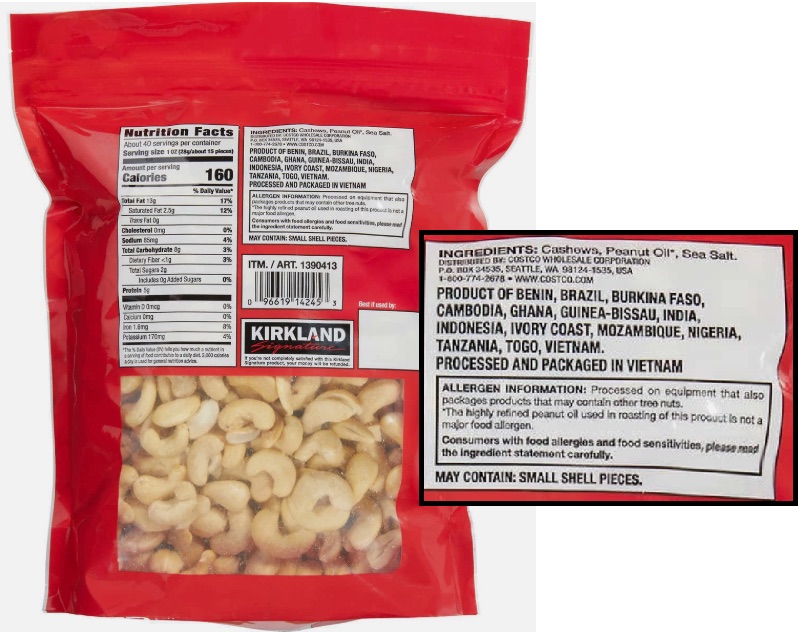
The plaintiffs allege that selling items obtained through opaque supply chains such as this is a violation of Costco’s pledge to have “direct insight in the entire supply chain” of Kirkland Signature products.
Second, the complaint alleges that Costco knew of reported child labor or forced labor concerns involving certain products or supply chains. The complaint cites the following sources in support of that allegation:
- Costco’s suppliers for its Kirkland Signature products admit in disclosures that certain products, like cashews, have problems with child labor in the supply chain.
- Independent investigations, such as those produced by the Corporate Accountability Lab, have uncovered abusive labor practices in suppliers that the complaint alleges are linked to Kirkland Signature items. One example in the complaint is farmed shrimp from India.
- Items sold under other brands at Costco, such as chocolate products sold by Nestle and Mars are also linked to problems with child labor in the supply chain by corporate disclosures or third-party reporting.
- Other products, such as coconut products from the Philippines and coffee from Columbia, have been linked to child labor by the United States Department of Labor. Costco sells many of these products without any independent certification that they are responsibly sourced.
Frequently Asked Questions
Who filed the lawsuit?
The lawsuit was filed by two Oregon Costco members. They will ask the court to appoint them as representatives of a class of all Oregon Costco members.
What is a class action?
A class action is a lawsuit brought by one or more individuals on behalf of a larger group of people who allegedly suffered similar harm. The plaintiffs in this case seek to represent Oregon Costco members who fall within the class definition proposed in the complaint. The Court has not yet decided whether a class should be certified.
What products are discussed in the complaint?
The complaint discusses a variety of products and product categories, including Kirkland Signature products and products containing ingredients such as cocoa, cashews, coffee, seafood, shrimp, dairy products, and pet food. The lawsuit does not challenge the safety of these products. Instead, it focuses on representations concerning sourcing practices, labor conditions, supply-chain transparency, and ethical sourcing.
Who is included in the proposed class?
The lawsuit seeks to represent Oregon consumers who purchased or renewed Costco memberships during the relevant time period identified in the complaint.
If I’m an Oregon Costco member, do I need to do anything right now?
The Court has not certified a class and no action is required in response to this lawsuit at this time. This is general information, not legal advice.
If the Court certifies a class or important developments occur in the litigation, additional information will be posted on this page. Any notice to potential or certified class members will be provided as authorized or directed by the Court.
If you want to be more involved or receive more information about the case, you can email Christine Ortez.
I believe I have information relevant to the issues in this case. How can I contact you?
If you believe you have information relevant to the issues in this case and would like to share it, we want to hear from you. Please contact us by emailing Brian de Haan.
Case Documents
- October 1, 2026 Complaint (PDF, 2 MB)
- October 1, 2026 Press Release (PDF, 105 KB)
Media Coverage
- Yahoo! Finance, October 3, 2026 Costco faces federal lawsuit accusing retailer of selling products linked to child and forced labor (opens in a new tab)
- Oregonian, October 1, 2026 Oregon lawsuit: Hundreds of Costco products are made with child or forced labor, seeks payout for each member (opens in a new tab)
Case Information Contact
Christine Ortez
Larkins Vacura Kayser LLP
121 SW Morrison Street, Suite 700
Portland, Oregon 97204
Media Contact
Brian A. de Haan
Larkins Vacura Kayser LLP
121 SW Morrison Street, Suite 700
Portland, Oregon 97204
About LVK
Larkins Vacura Kayser LLP represents investors, consumers, businesses, and governments in complex civil litigation, including class actions, securities litigation, business disputes, antitrust matters, consumer protection matters, and other high-stakes litigation throughout Oregon and the Pacific Northwest. The firm is recognized as a Tier 1 Best Law Firm by U.S. News & World Report and is ranked by Chambers for general commercial litigation in Oregon.
This website provides general information, not legal advice. Information made available on this website does not create an attorney-client relationship, and receiving such information does not establish one. Representation by Larkins Vacura Kayser LLP requires a formal engagement. This website contains attorney advertising and is subject to the Rules of Professional Conduct.